Research
Our research is organized around three pillars: (1) structured representations of nonlinear dynamics, (2) operator-theoretic analysis and interpretable reduced coordinates, and (3) optimization, control, and learning of dynamical systems.
Research highlight: transonic buffet
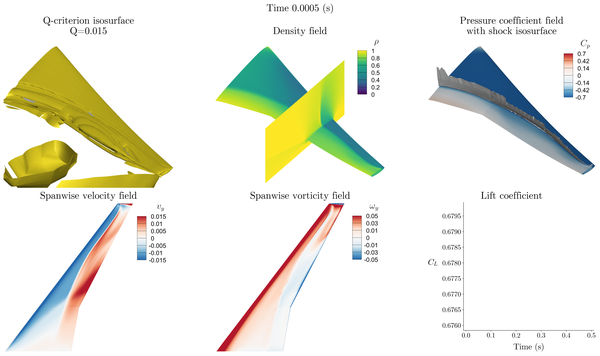
Transonic buffet—self-sustained shock and shear-layer oscillations—limits the cruise envelope of modern transport aircraft and emerges through a Hopf bifurcation of the steady flow. Led by Ph.D. student Rohit Kanchi, we predict buffet onset from first principles with linear stability analysis (LST) of the steady base flow, and we developed a coupled adjoint that computes the sensitivity of the dominant LST eigenvalue with respect to a large number of shape design variables. A buffet-constrained drag minimization of the OAT15A supercritical airfoil achieves a 22.4% drag reduction while satisfying the LST-based buffet constraint. This work received the 2026 AIAA MDO Best Student Paper Runner-Up award.
We are extending the approach to three-dimensional buffet on swept wings. The simulation below was computed using ADflow, a state-of-the-art RANS-based finite-volume solver, on NASA’s Common Research Model (CRM) wing in the wing-only configuration, at Mach 0.85, angle of attack 4.2 deg, and Reynolds number 5 million.
Publication:
 | Rohit Sunil Kanchi, Sicheng He, Eirikur Jonsson, Joaquim R. R. A. Martins. Buffet Alleviation via Linear Stability Adjoint AIAA AVIATION Forum (2026). 2026 AIAA MDO Best Student Paper Runner-Up. |
1. Structured representations of nonlinear dynamics
How do we build compact, structured representations of nonlinear time-dependent dynamics?
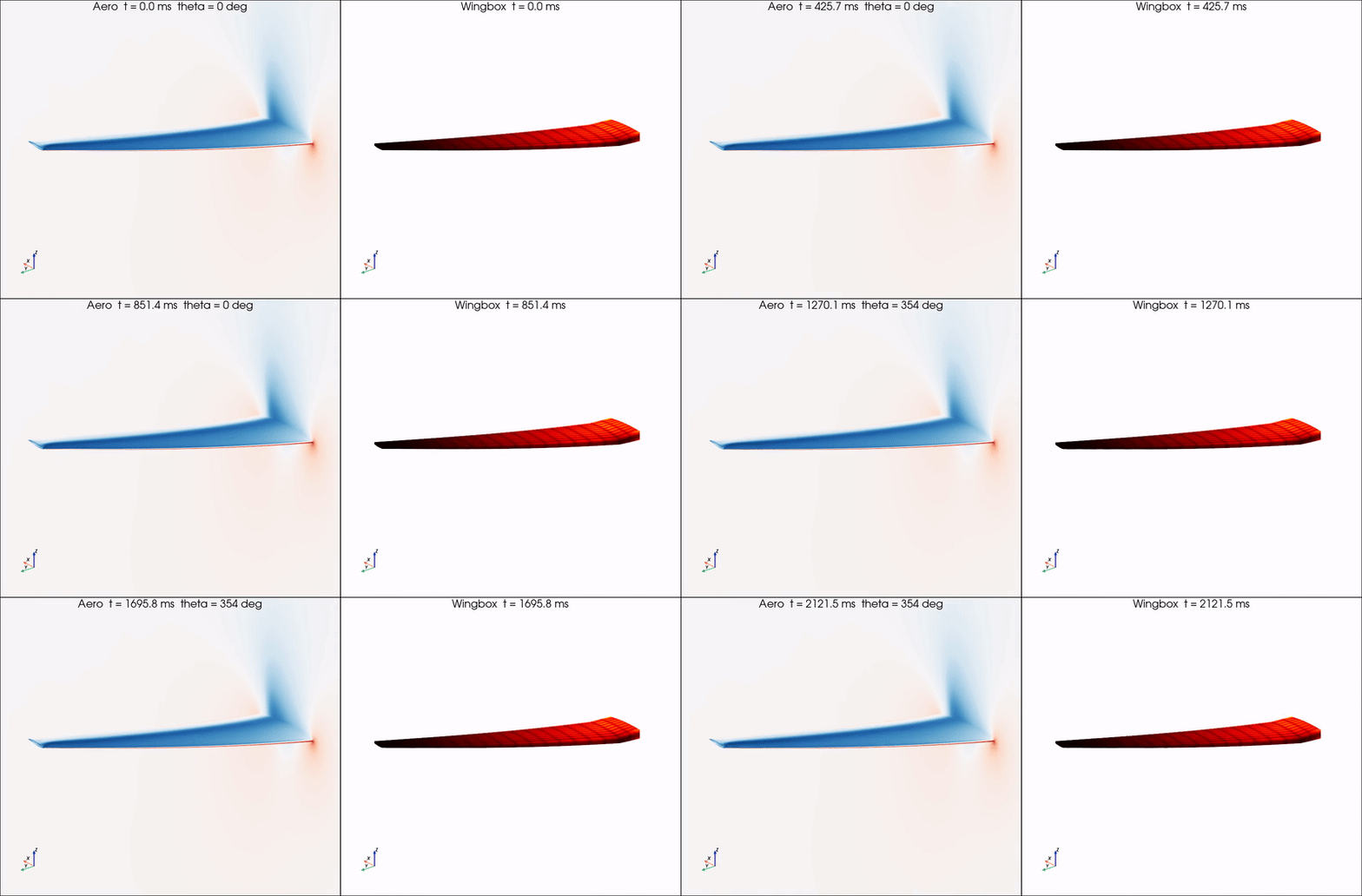
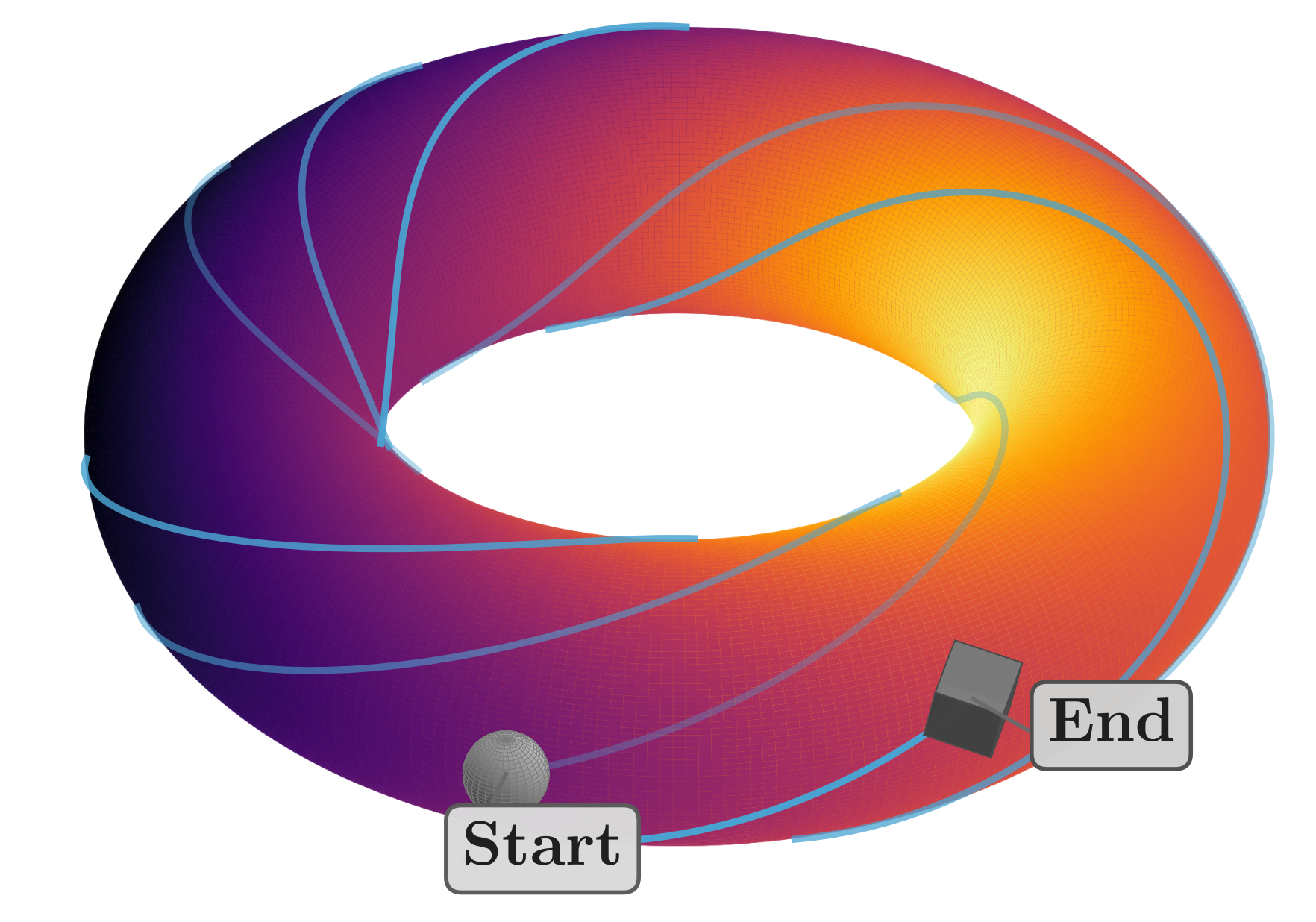
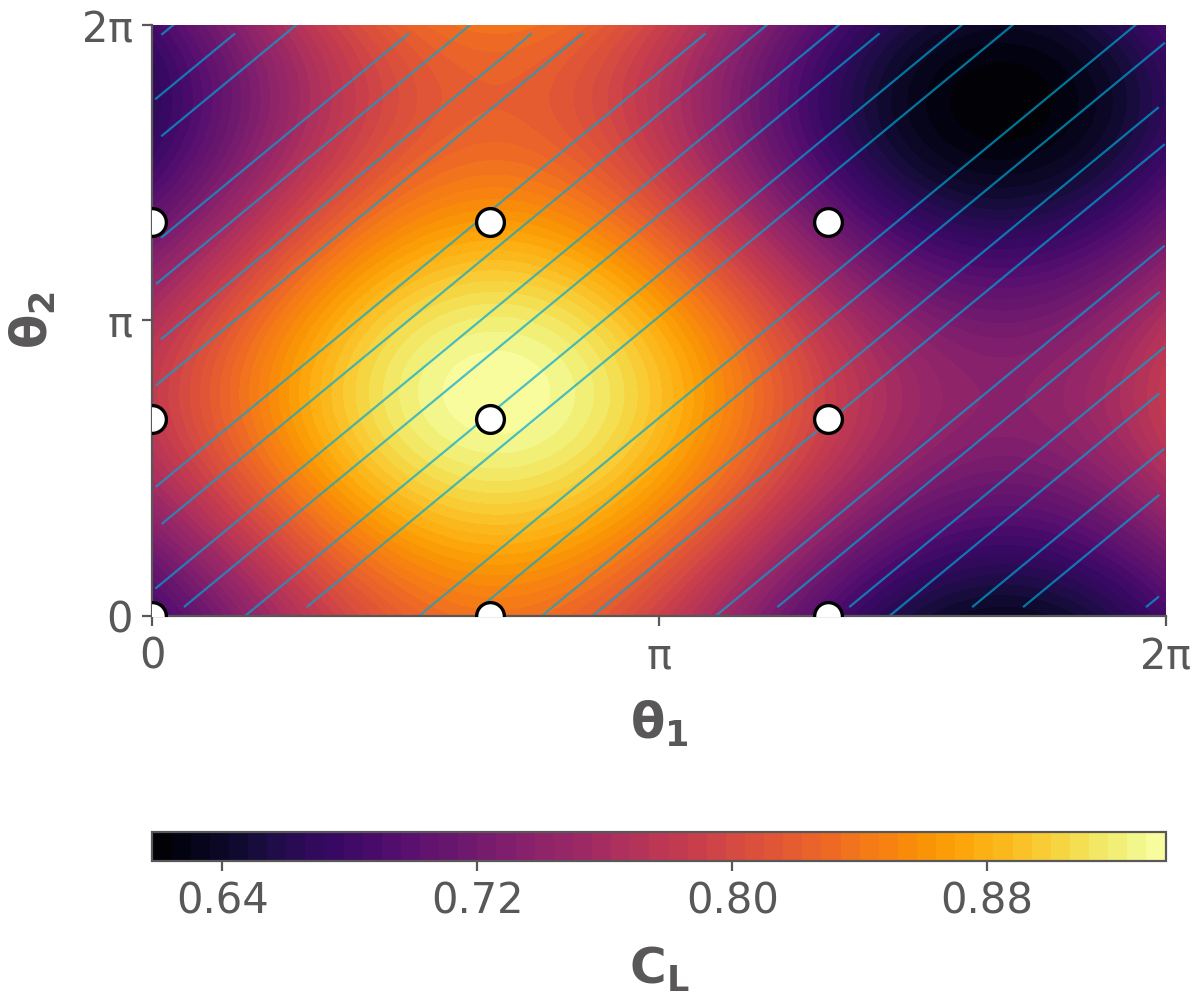
We develop spectral and frequency-domain frameworks that replace brute-force time marching with structure-exploiting representations of periodic and quasi-periodic behavior. Our work follows a natural progression: represent the motion via time-spectral methods, generalize to multi-frequency motion via torus methods, and characterize stability of the represented motion via Floquet theory.
Key contributions include the torus time-spectral method (TTSM) that lifts governing equations to an extended angular phase space with spectral convergence, spectral Floquet analysis for orbital stability of periodic systems, time-spectral resolvent analysis for frequency response of periodically varying base flows, and the first fully coupled CFD–FEA time-spectral aeroelastic solver that captures forced periodic wing oscillations in the frequency domain at a fraction of the cost of time marching.
Publication:
 | Sicheng He, Hang Li, Kivanc Ekici. Torus Time-Spectral Method for Quasi-Periodic Problems arXiv preprint (2025). |
 | Sicheng He, Rohit Kanchi. Torus Time-Spectral Method for Three-Dimensional Wing Oscillations with Two Incommensurate Frequencies in preparation. |
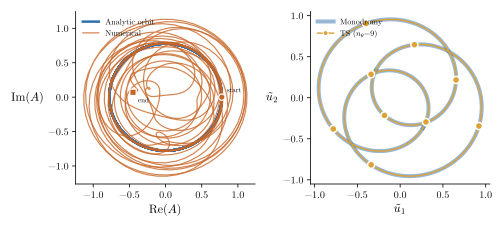 | Sicheng He, Max Howell, Dan Wilson. Time-Spectral Method-Based Efficient Floquet Analysis in preparation. |
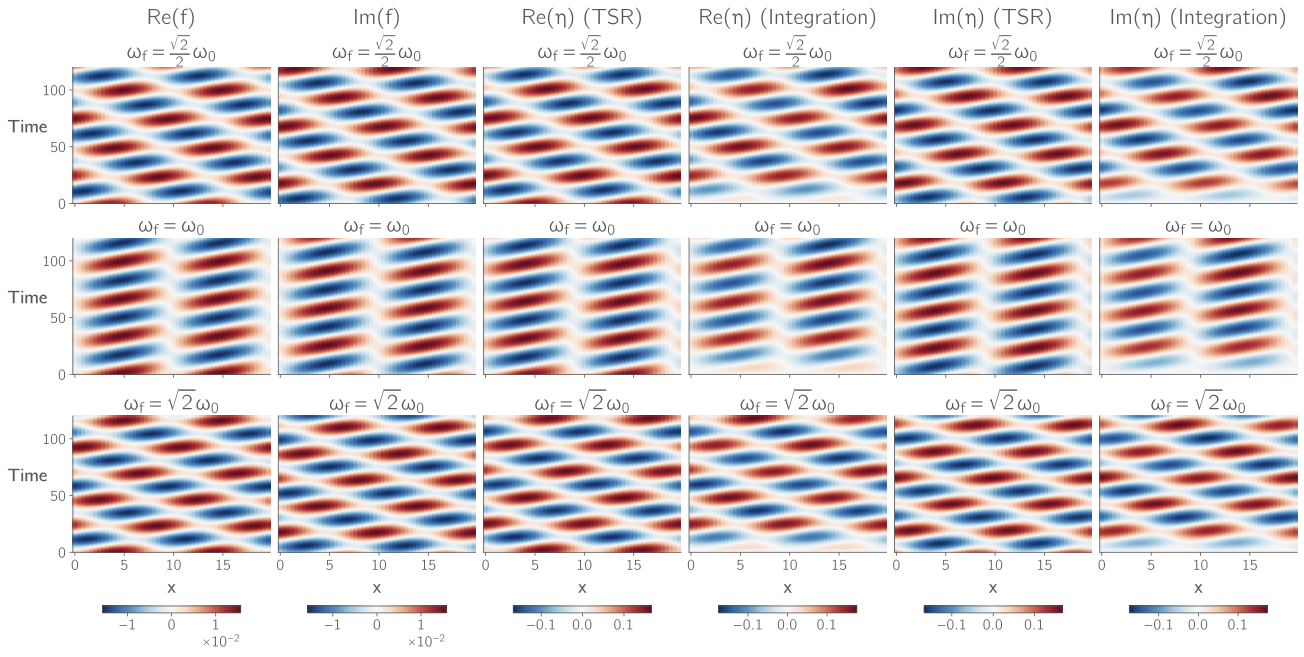 | Max Howell, Sicheng He. Time-Spectral Resolvent Analysis for Periodic Dynamical Systems SIAM Journal on Applied Dynamical Systems (submitted) (2026). |
| Sicheng He. Coupled Time-Spectral Aeroelastic Analysis Using High-Fidelity CFD and Finite Element Structural Models in preparation. |
2. Operator-theoretic analysis and interpretable reduced coordinates

How do we extract the dominant mechanisms, coordinates, and sensitivities from large-scale nonlinear systems?
We build modal and operator-based tools to turn simulation data or linearized operators into understanding: what modes matter, what forcing/response structures dominate, and how sensitivities propagate through modal objects. Critically, our analysis tools are not passive diagnostics—they are made optimization-ready through differentiable formulations that connect directly to gradient-based design.
Key contributions include the first fully matrix-free resolvent analysis for 3D aerodynamic systems (NASA CRM, 1.8 million cells), differentiable resolvent analysis for flow control optimization, and differentiable POD for optimization-compatible modal decompositions and field inversion.
Publication:
 | Sicheng He, Rohit Kanchi. Matrix-Free Resolvent Analysis for Large-Scale Aerodynamic Systems in preparation. |
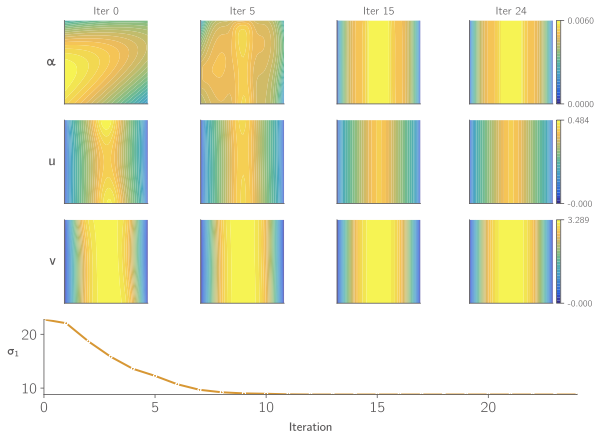 | Sicheng He, Shugo Kaneko, Daning Huang, Chi-An Yeh, Joaquim R. R. A. Martins. Large-Scale Flow Control Performance Optimization via Differentiable Resolvent Analysis in preparation. |
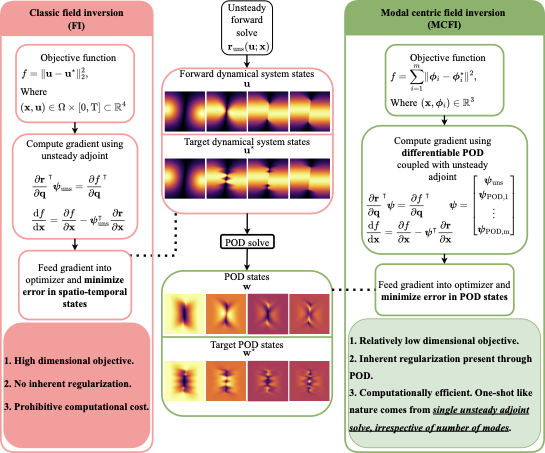 | Rohit Sunil Kanchi, Sicheng He. Modal-Centric Field Inversion via Differentiable Proper Orthogonal Decomposition Journal of Computational Physics (major revision submitted) (2026). |
3. Optimization, control, and learning of dynamical systems
How do we control, optimize, and learn within structured dynamical representations?
Once dynamics are represented and interpreted, we ask: how do we modify them—suppress instability, improve performance, learn closures, and design systems with dynamics as first-class constraints? We combine adjoint methods, multidisciplinary optimization, and scientific machine learning to design, stabilize, and infer complex engineering systems governed by multiscale dynamics.
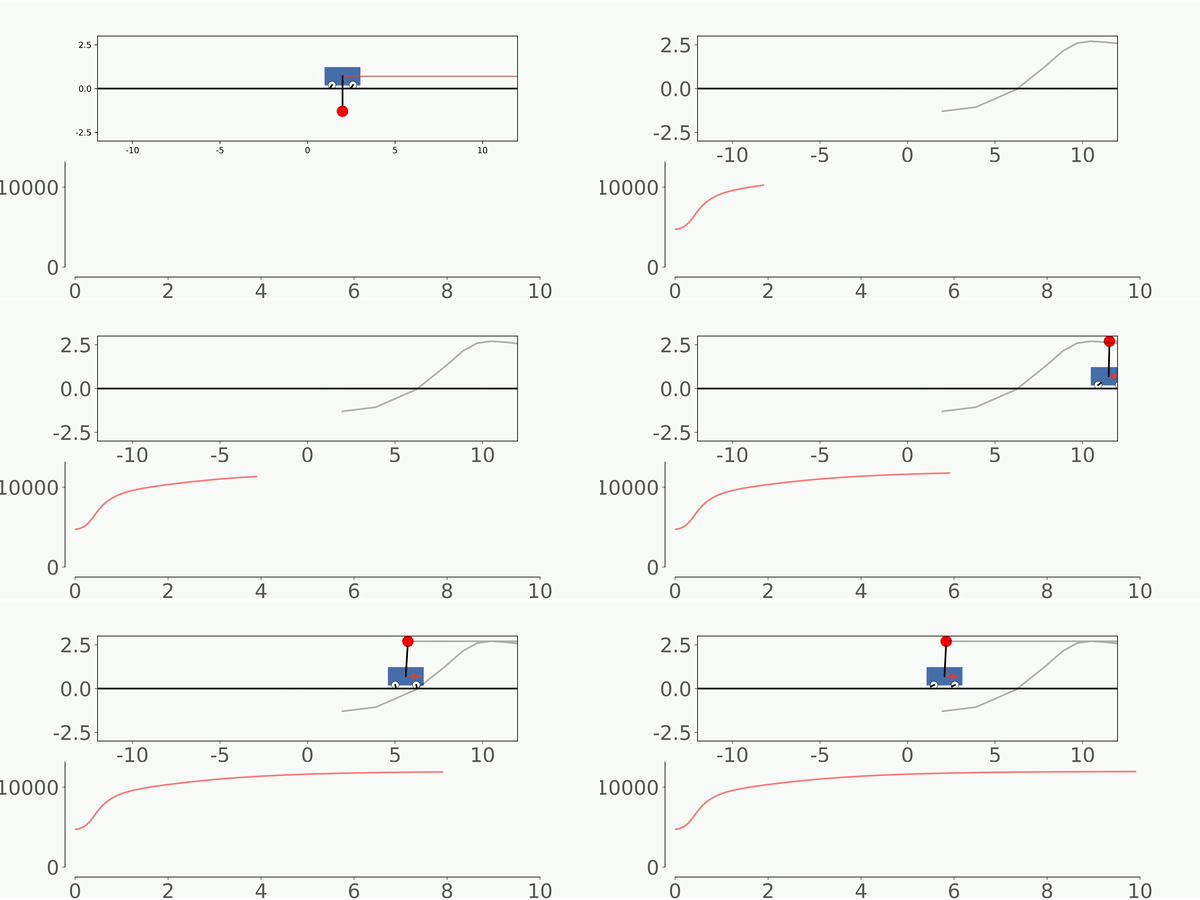
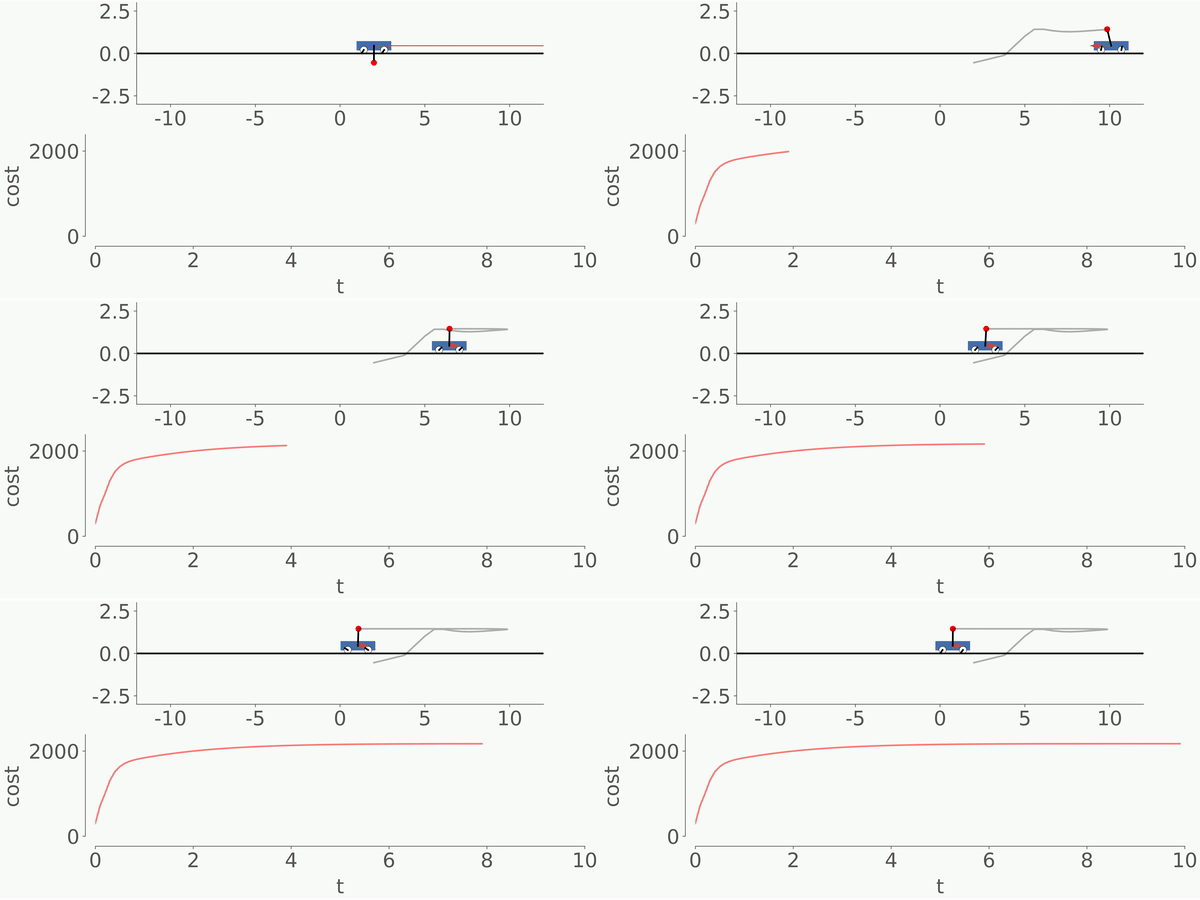
Key contributions include adjoint-based stability-constrained design optimization, Hopf-bifurcation instability suppression via the first Lyapunov coefficient, adjoint-based control co-design, including co-design of legged robots with parallel elasticity, a fundamental reverse algorithmic differentiation method for complex analytic functions yielding the first succinct eigenvalue derivative formula for general complex matrices, gradient-enhanced neural network surrogates for real-time aerodynamic analysis (Webfoil), the differentiable Kalman filter for physics-informed state estimation with 90% error reduction, and the UniFoil dataset of 500,000 airfoil simulations for scientific machine learning.
Publication:
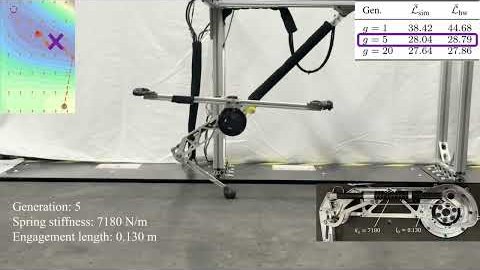 | Yulun Zhuang, Yue Qin, Justin Lu, Zelin Shen, Yichen Wang, Sicheng He, Yanran Ding. SurGE: Surrogate Gradient-guided Evolution for Co-design of Legged Robots with Parallel Elasticity IEEE/RSJ International Conference on Intelligent Robots and Systems (IROS) (2026). [Project page] [Video] |
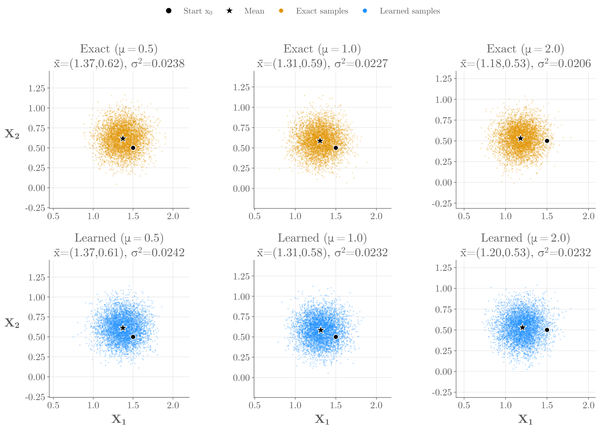 | Minglei Yang, Sicheng He. Training-Free Score-Based Diffusion for Parameter-Dependent Stochastic Dynamical Systems Advances in Computational Science and Engineering (2026). |
| Jianing Chen, Yan Li, Sicheng He, Daning Huang. Eigenvalue- and Gradient-Aware Optimization for Small-Signal Stability via the Adjoint Method IEEE Transactions on Power Systems (2026). | |
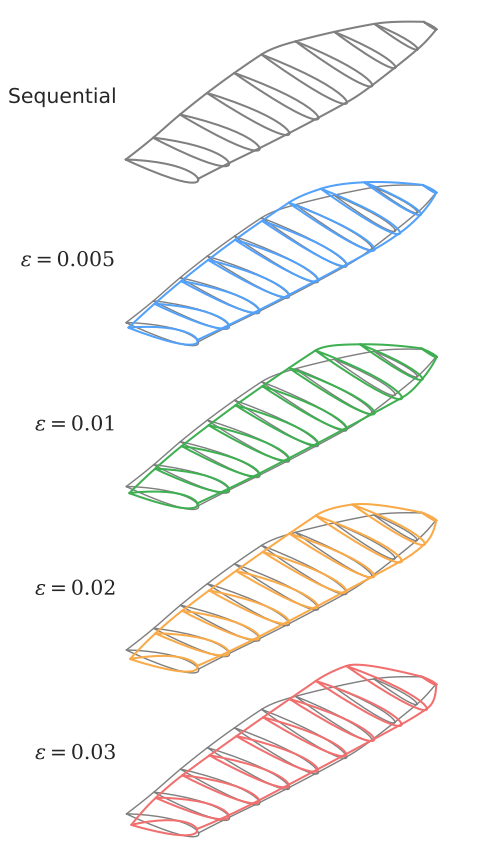 | Sicheng He, Shugo Kaneko, Max Howell, Nan Li, Joaquim R. R. A. Martins. Efficient Adjoint-based Design Optimization with Optimal Control Journal of Mechanical Design (accepted) (2026). |
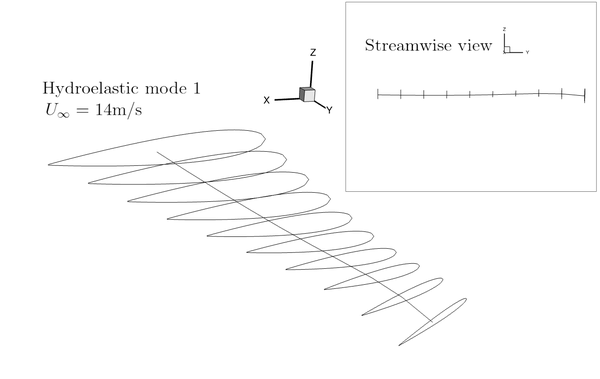 | Galen W. Ng, Shugo Kaneko, Eirikur Jonsson, Sicheng He, Joaquim R. R. A. Martins. Hydroelastic Optimization of Submerged Composite Foils with Flutter and Ventilation Constraints Structural and Multidisciplinary Optimization (accepted) (2026). |
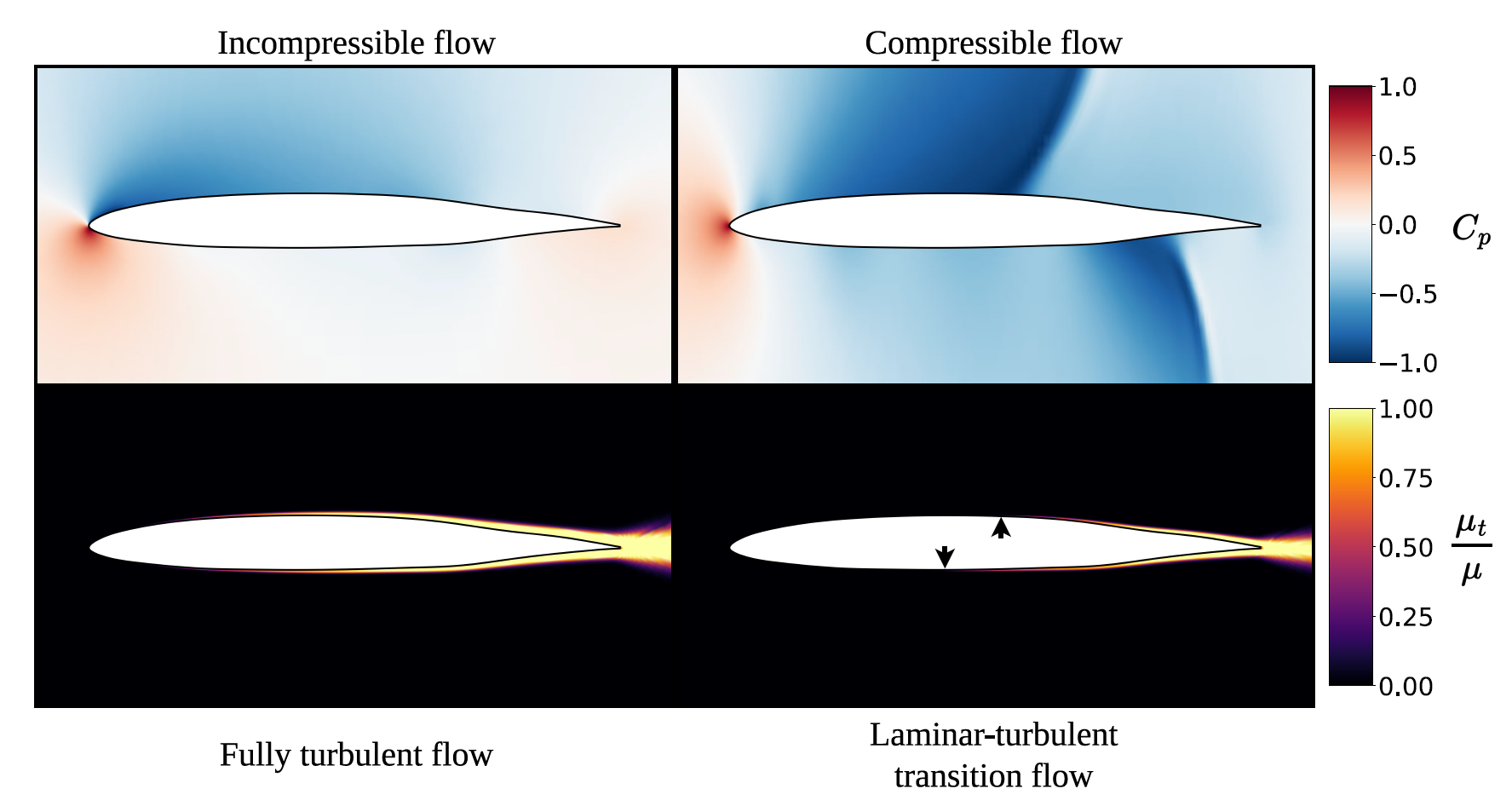 | Rohit Sunil Kanchi, Benjamin Melanson, Nithin Somasekharan, Shaowu Pan, Sicheng He. UniFoil: A Universal Dataset of Airfoils in Transitional and Turbulent Regimes for Subsonic and Transonic Flows NeurIPS Datasets and Benchmarks Track (2025). |
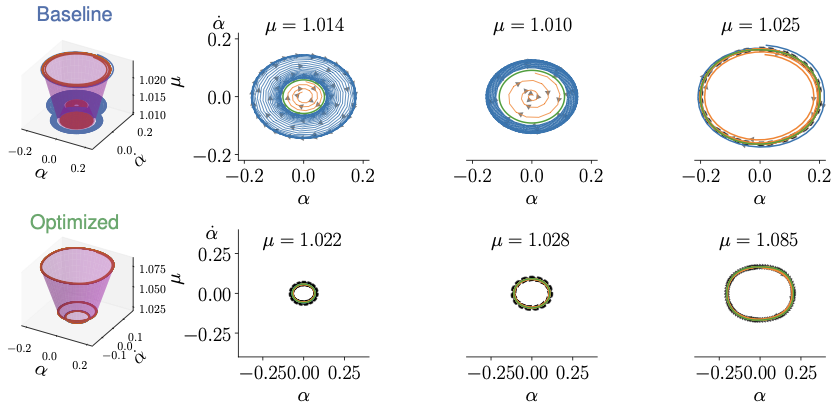 | Sicheng He, Max Howell, Daning Huang, Eirikur Jonsson, Galen W. Ng, Joaquim R. R. A. Martins. Adjoint-based Hopf-bifurcation Instability Suppression via First Lyapunov Coefficient AIAA Journal (major revision) (2025). |
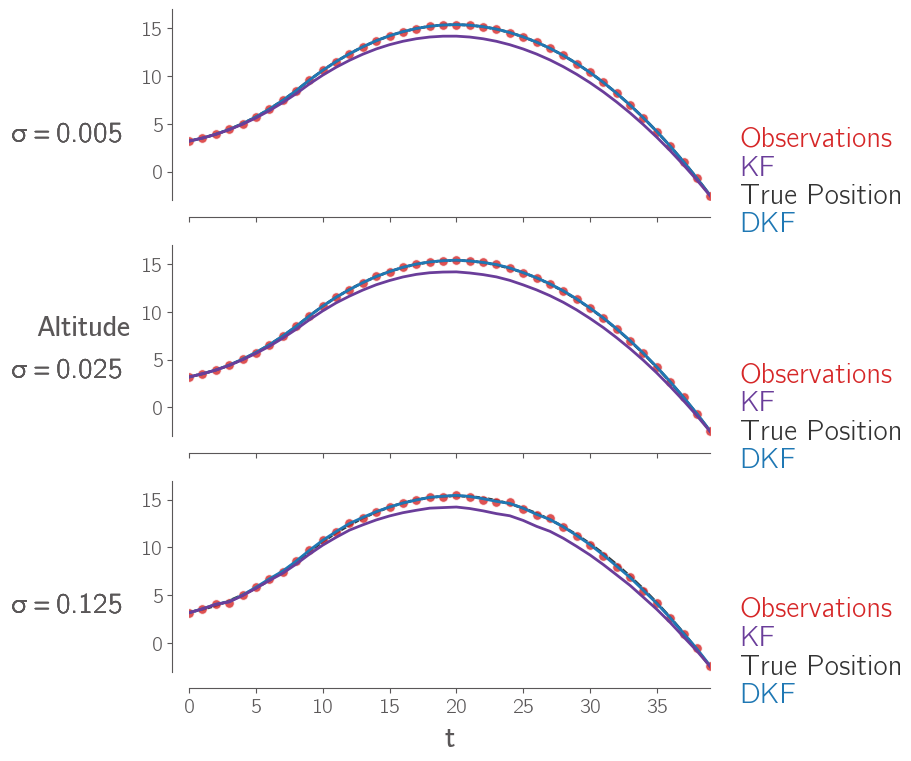 | Yuan Wu, Sicheng He. DKFNet: Differentiable Kalman Filter for Field Inversion and Machine Learning Journal of Computational Physics (under review) (2025). |
 | Sicheng He, Eirikur Jonsson, Jichao Li, Joaquim R. R. A. Martins. Adjoint-Based Design Optimization of Stability Constrained Systems AIAA Journal (2024). |
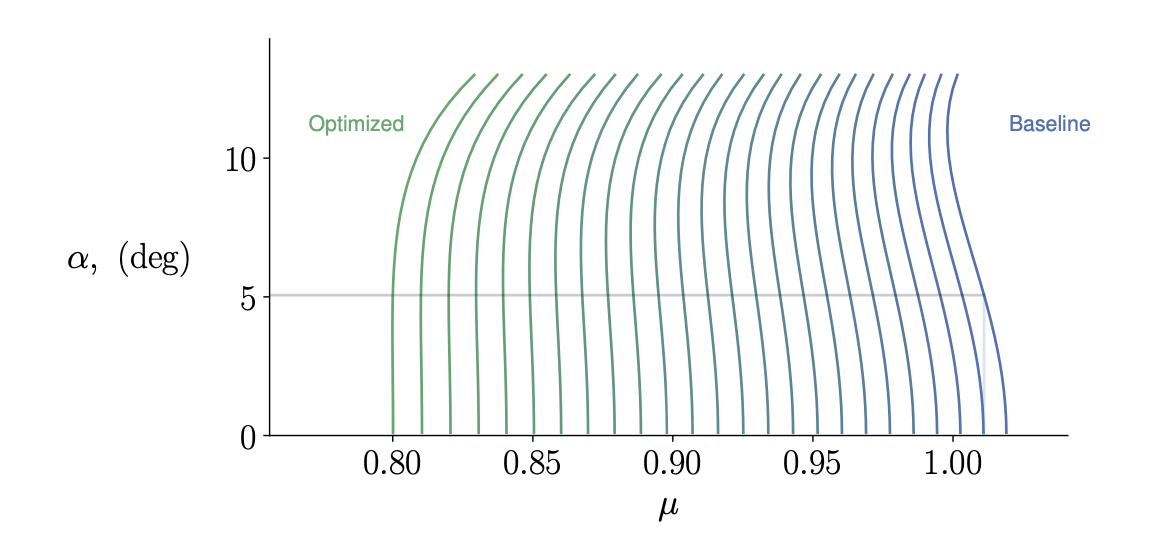 | Sicheng He, Eirikur Jonsson, Joaquim R. R. A. Martins. Adjoint-based Limit Cycle Oscillation Instability Sensitivity and Suppression Nonlinear dynamics (2022). |
 | Sicheng He, Yayun Shi, Eirikur Jonsson, Joaquim R. R. A. Martins. Eigenvalue problem derivatives computation for a complex matrix using the adjoint method Mechanical Systems and Signal Processing (2023). |
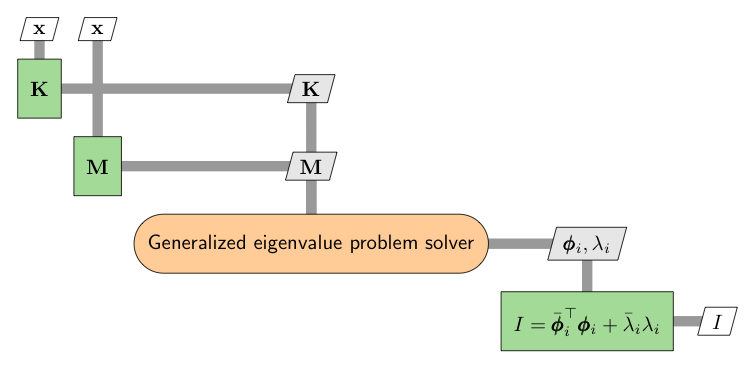 | Sicheng He, Eirikur Jonsson, and Joaquim R. R. A. Martins. Derivatives for Eigenvalues and Eigenvectors via Analytic Reverse Algorithmic Differentiation AIAA Journal (2022). |
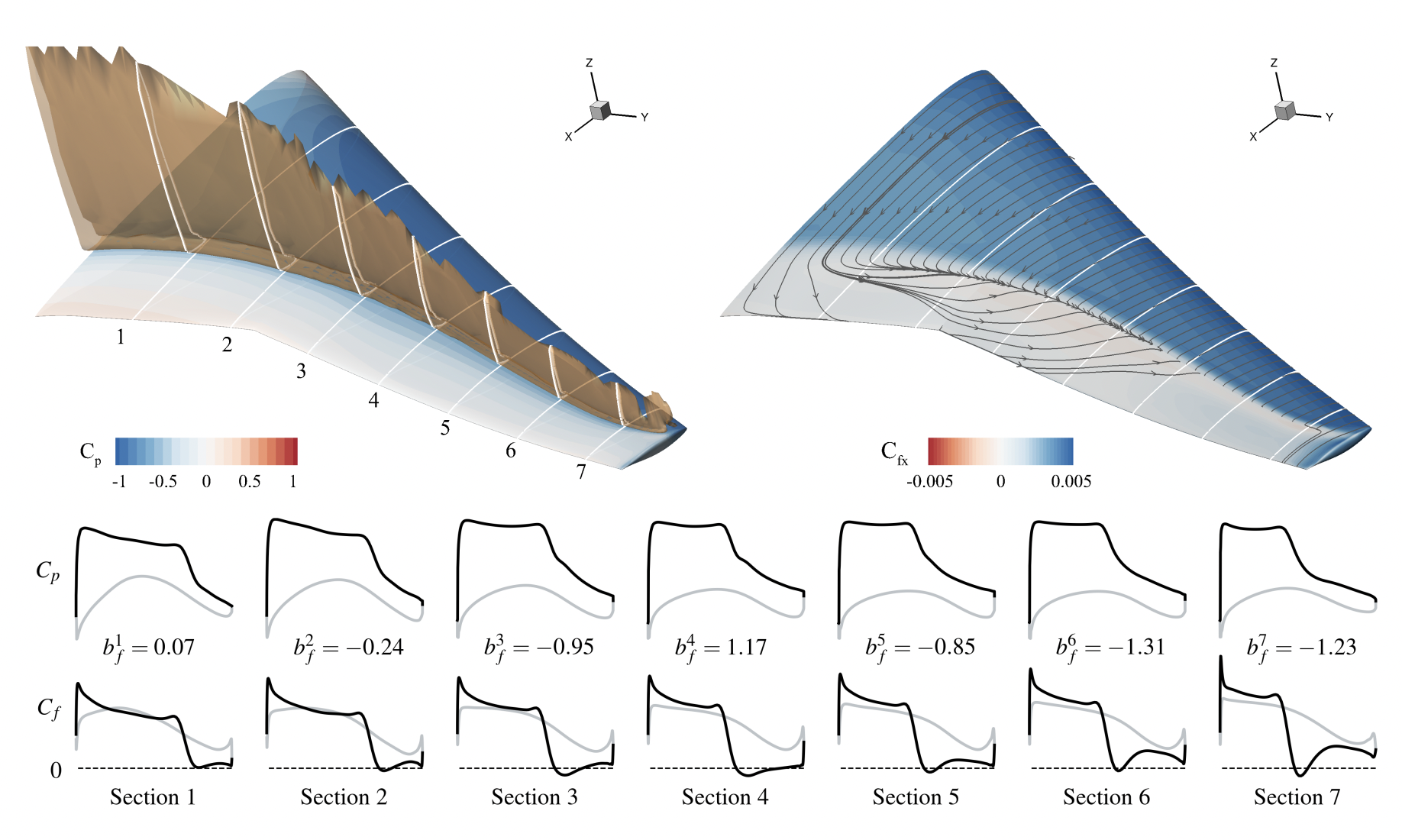 | Jichao Li, Sicheng He, Mengqi Zhang, Joaquim R. R. A. Martins, Boo Cheong Khoo. Physics-Based Data-Driven Buffet-Onset Constraint for Aerodynamic Shape Optimization AIAA Journal (2022). |
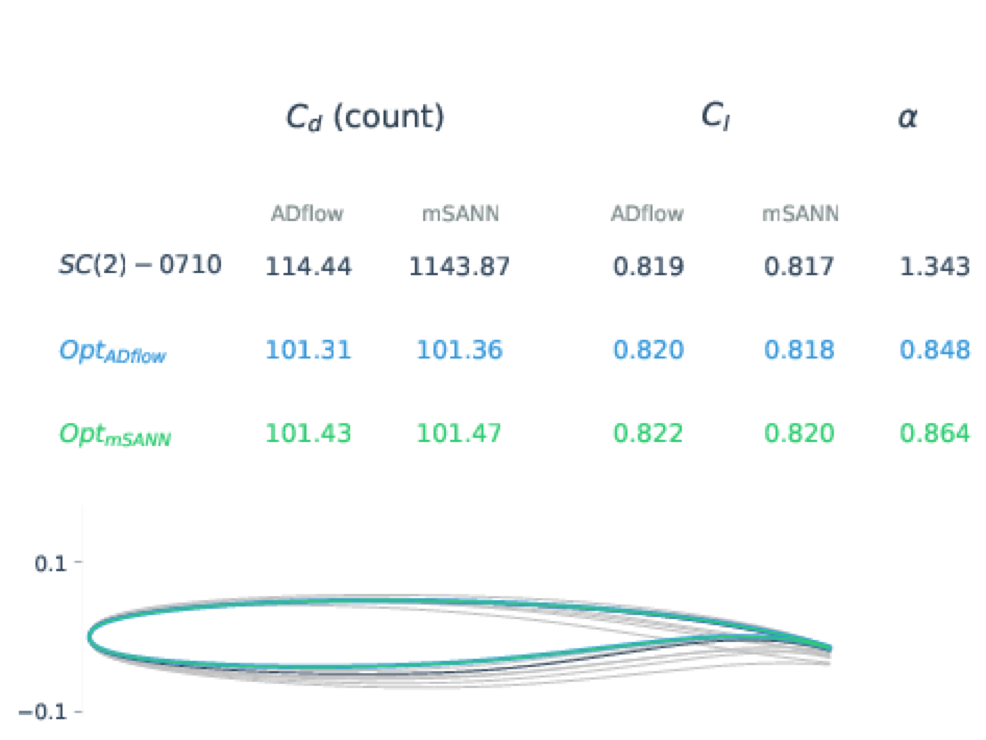 | Mohamed Amine Bouhlel, Sicheng He, and Joaquim R. R. A. Martins. Scalable gradient-enhanced artificial neural networks for airfoil shape design in the subsonic and transonic regimes Structural and Multidisciplinary Optimization (2020). (Webfoil) |
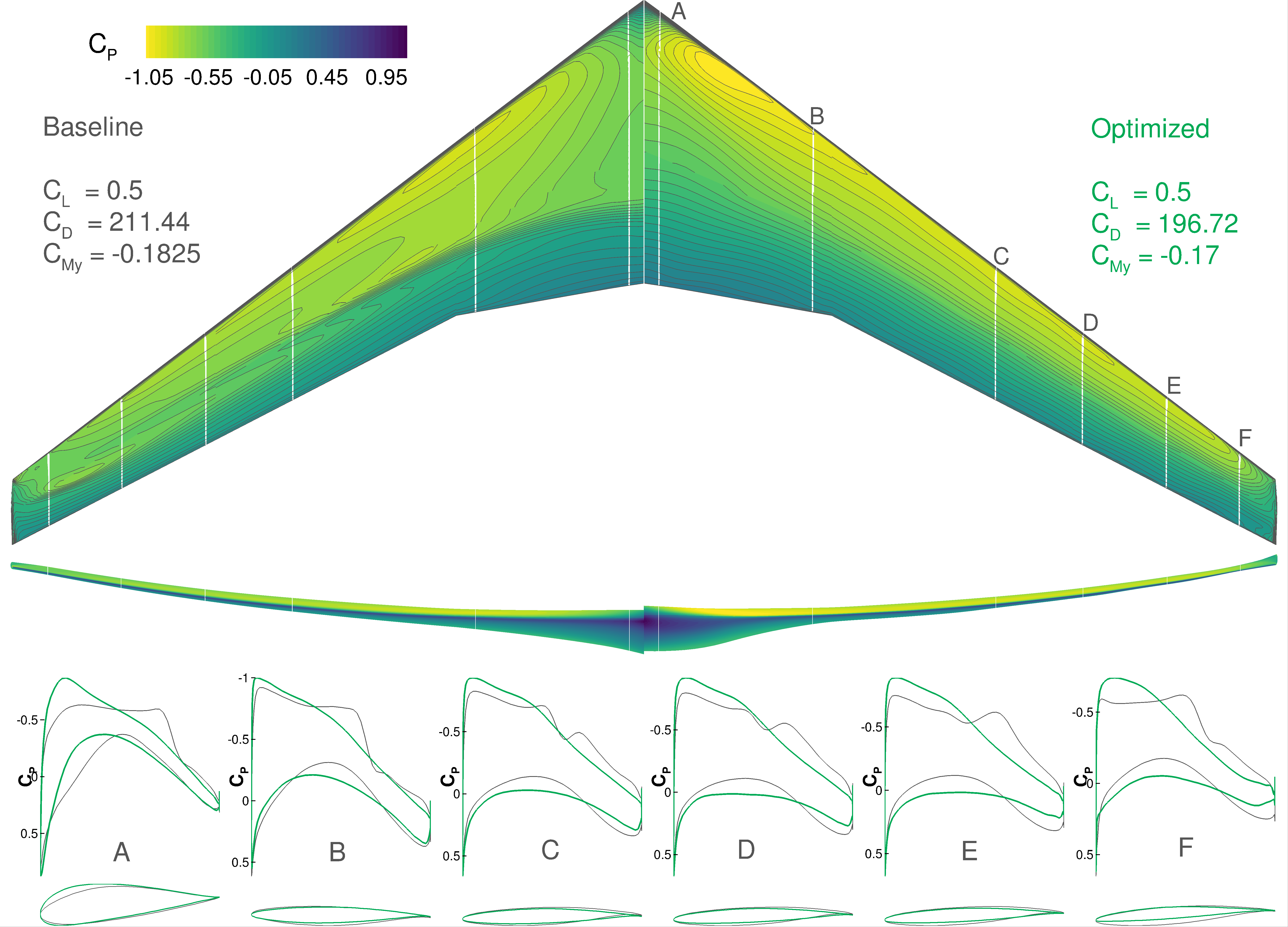 | Jichao Li, Sicheng He, and Joaquim R. R. A. Martins. Data-driven constraint approach to ensure low-speed performance in transonic aerodynamic shape optimization Aerospace Science and Technology (2019). |
Past research projects — aeroelastic optimization, wind turbine MDO, laminar-turbulent transition, structural global optimization.